
|
|

March 2020
Going beyond the Broom
In December 2018, The President of Zimbabwe, E.D. Mnangagwa, started the National Environment Cleaning Campaign with a dream to turn Zimbabwe into one of the cleanest countries in the world.
Early in March 2020, the article appeared in local press "National clean-up campaign: Going beyond the broom". The article stated that one of the many ways of tackling the litter challenge is to develop a greater sense of civic pride among citizens. The clean-up campaign has raised awareness about the scale of the litter problem and has forced people to think about changing their behaviour. Many schools have supported the Campaign and have reflected the initiative in their Art lessons.
December 2018 - March 2020
Living Values through Art
Inspired by "Living Green Values", primary and secondary school children at the Dominican Convent School in Harare, Zimbabwe, expressed through their artwork the awareness of the importance of taking care of Zimbabwe, the Earth and their resources.
The first category: "I take care of my world" - depicted their love for nature and concern for clean environment.


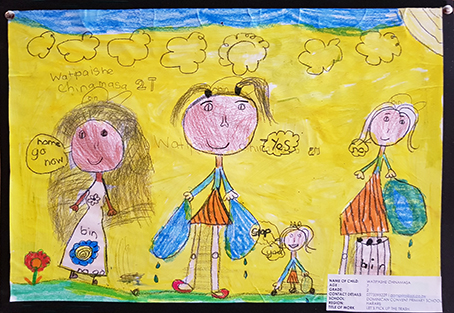

"Let's pick up the trash" by Grade 2


"Clean and Green" by Grade 2

Take care of my World by Grade 5
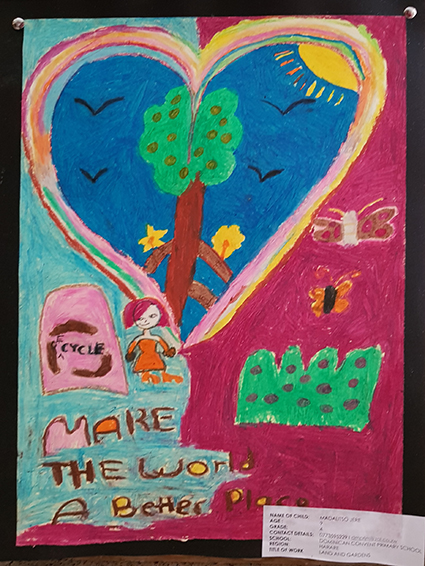

Land and Gardens by Grades 3 & 4


A Healthy and Beautiful Planet by Grades 3 & 4
Expressing Values in Art: The second category (for grades 6-8) focused on self-development.

Looking through Blinds of Lace Curtains
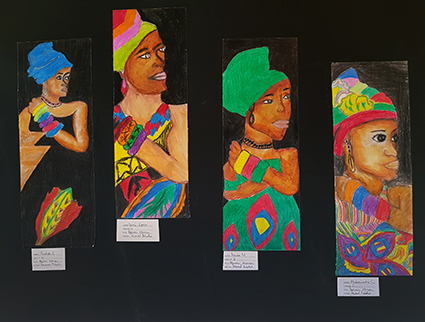
African Women

We Are One!

Purity and Peace

Welcome to Zimbabwe

African

Me!

Obstructed Emotion
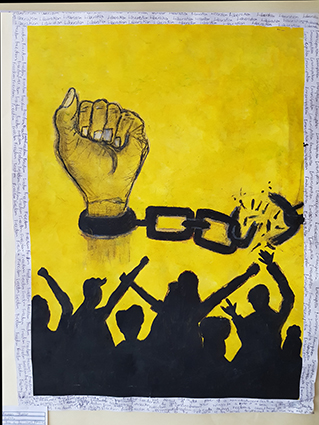
Freedom
2019
LVE School Assembly, Harare: 19 March 2019
Living Values Education is a part of school assemblies and it blends perfectly well with the school Catholic ethos. A group of Upper 6 students have prepared presentation, posters and value-cards for one of the assemblies. LVE team spoke about 12 universal values and about the importance of sharing values for a better world. Power point presentations, songs and poems have become a part of the presentation. Exploring and developing universal values for a better world"¦ Peace, Respect, Love, Happiness, Freedom, Honesty, Humility, Tolerance, Cooperation, Responsibility, Simplicity, Unity. These assemblies are ongoing.
The feedback after the Values Assembly:
- I saw the description of the card "COMMITMENT" on the status of one of my friends. It seems that many people have really liked the cards and were inspired by them! Thank you so much for taking the time to do this. I am sure it was much appreciated by a lot of people.
- Thank you for yesterday's assembly. I've picked the value, which is me - "CONSIDERATION". It's amazing. I consider myself to be a considering person.
- Thank you for the beautiful assembly and for checking up on me after the lesson... it really meant a lot to me.
- Thanks for beautiful cards. They have made a great impact on me and my classmates. We were showing each other our descriptions - sharing our values. We need more assemblies like that.


Are you worthy of GOD'S LOVE?
The Father has loved me, so haveI loved you. Abide in my love. If you keep my commandments, you will abide in my love, just as I have kept my Father's commandments and abide in his love.
John 15:9-17
Know therefore that the LORD your God is God, the faithful God who keeps covenant and steadfast love with those who love him and keep his commandments.
Deuteronomy 7:9
Living Values for Mental Health: Understanding, Respect, Unity and Peace.
Maleeha Nawaz, a teacher from Pakistan, who ended up in Zimbabwe through marriage, describes her 10th year of teaching at a high school.

Maleeha Nawaz
Nawaz writes: "Year 2019 had made a tremendous impact on my teaching career. I noticed that most children were frequently anxious, stressed and depressed. Being someone who understands stress and how damaging it can be, I have always encouraged candid and heartfelt discussions in my lessons so it was easier for me to pick up on the issues that affected them. Every time I entered the classroom, I felt what they felt. I felt their pain, I felt the oppressive energy in the classroom and I knew they were hurting. Frequently, we forget what younger people go through and disregard their thoughts and ideas because we think we know better.
"I wish it was as simple as asking what was bothering them, what was heavy on their heart, what was hurting them. I knew that they had problems that needed solving but how would I help them? I desperately wanted to share their pain and see them thrive.
"The idea came up to create a wholesome environment somewhere away from school. Let them try something different but fun, something that pushes them but also gives them peace...
"...It was a crisp, bright beautiful morning on 27 November 2019, when we arrived at Raintree School Camp. My friend Carmen, a yoga instructor and health coach, led us into a session of yoga. I looked at the bemused, apprehensive faces of my students who hadn't tried yoga before. Through breathing, they were showing respect for the postures. Inhaling and exhaling tension, they were calm and connected. Then they were asked to lay their heads on someone else's tummy and form a conduit in order to transfer positive energy through contact. What I saw was transforming. "Gone were the strained expressions and fear that often clouded some of their faces. Giggling, laughing and chuckling without restrain. It was beautiful.
"Next, we formed a circle and sat on the lush grass, asking them to contemplate and ponder at which point in their lives they were. Questions were asked and they answered from the heart. I told them they were special, important and unique. I sensed understanding, respect and peace creep on their vulnerable faces. They were absorbing and internalizing. We all had our battles but we were one. United. We were human.
"After lunch we had a surprise in store. Secret Sunshine. Connection through guided dance and movement. Everyone was given headsets and then it began. We were soaring, flying, dancing the best way we could. Free from judgement. Connected. We were one. What I saw made my heart so full. Inexplicable joy and nothing else. I felt I was seeing different children that day, children who only knew joy and excitement.
"I have never been so moved when they shared their experiences with me. For the first time in a long time they felt happiness. One of them said that day when she went home she was locked out of her house but just remained calm and happy and didn't care about her distressing situation. Another shared she dissolved into tears when she went home that day but tears of relief, comfort and gratitude. Most of them said they slept well for the first time in years without waking up several times in the night.
"...Peace and joy. I am so grateful for the trust they have put in me and I am honoured to be their teacher."
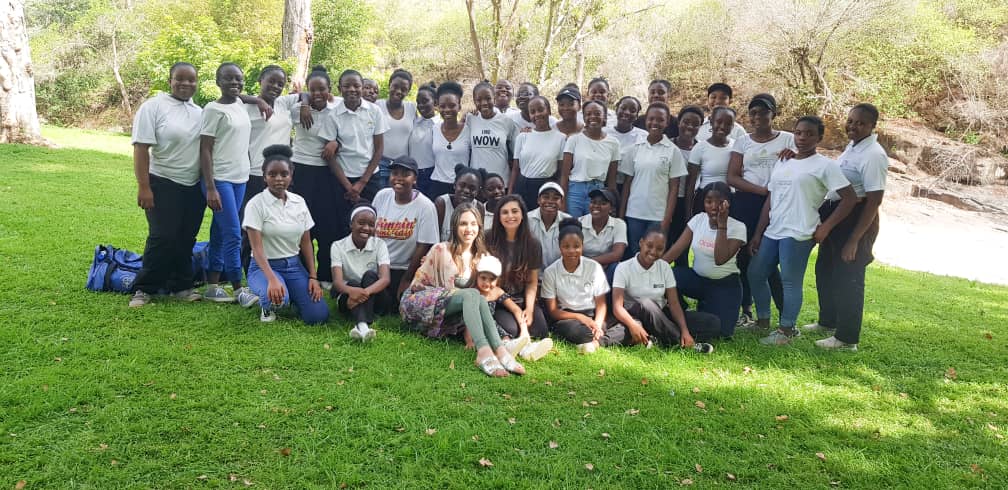
Raintree School Camp team

Meditation experience
2017
Inspirational teaching: Classroom management through LVE
As the schools in Harare, Zimbabwe closed for Christmas holidays in December 2016, the teachers headed to one of the most popular workshops "Inspirational Teaching: Classroom Management through Living Values". Many veteran teachers shared their experiences, skills and methods with younger, not so fully-fledged teacher.
Fruitful discussions were held on the following issues:
- Identify most frequent disciplinary problems
- Share most effective strategies in managing classroom
- Share experiences with progressive discipline, where values-based approach succeeded in improving behaviour and attitudes of the students, and they turned to be well-behaved in the end
Many teachers indicated that good behaviour has to be acknowledged and complimented. Some schools offer house points or merits, even if the mark is below standard, to encourage positive performance. It is essential not only to make a student understand what he/she has done wrong, but also understand the students and why they have done something wrong. Teachers should never stop to be role models and they themselves should demonstrate the behaviour they expect from the students.
Effective ways of behaviour modification proved to be:
- talking to students one-on-one with respect
- putting students in leadership positions
- reinforcing positive behaviour
- constant reminder of the school rules
Some teachers specified the importance of working with parents, as many schools have limited opportunity to do that. Traditionally, schools in Zimbabwe offer only one parents' consultation day per year to discuss the students' academic achievements. Some students come from poor background or broken families, so cultural ethics allowing, careful research should be done on how families contribute to behavioural problems in students. Perhaps, LVE Effective Parenting Workshop or LVE Parenting Classes can be a solution.
Overall, both experiences and young teachers benefited from the workshop and found many ideas applicable in their classroom practices. All the teachers are determined to make their students feel loved, valued, respected, understood and safe.

How to eliminate disciplinary problems at an early stage

Effective classroom strategies

Progressive discipline

Problems and strategies

Listening carefully

Working with parents
2016
Zimbabwe: 25 May Movement
 The 25 May Movement is a campaign that started early this year, inspired by the growing negativity and hopelessness of Africans, and more specifically, Zimbabweans. It was the brainchild of a seventeen-year old Tanatsei Gambura, one of the contributing artists in the poetry anthology "Fresh Ink", who saw the need to highlight just a few of the things that make being African such a fulfilling gift. The idea is to remind people that although things are tough, and for many Africans even waking up is a struggle, things won't change until our mindset changes. There is more to being African than the western stereotypes and overrated names. There is more to being African than what we are told.
 The movement is the effort of fifteen girls who are planning on sharing a smile and a few words with fellow Africans in Harare in order to change outlooks and mindsets. The group is also set to release a spoken word video on Africa Day of a thought-provoking poem entitled "We Are Africans", written by Tanatsei and filmed by One Point Eight Pictures. In collaboration with Star FM, the team is set to share a message about Africa throughout the week on radio.
  The movement is planned to spread to social media, with the hashtag #25maymovement and pictures of the girl's outdoor campaign. Catch the movement, join the campaign and celebrate Africa!
Natasha Ncube
Focal Point for LVE in Zimbabwe
2014
Workshops To Help Grade Seven Students Transition to Secondary School
 Natasha Ncube, the Focal Point for LVE in Zimbabwe, has been kept very busy with a series of workshops for grade 7 pupils in several primary schools in Harare between December 2013 and April 2014. She was asked to conduct the workshops by the school's Parent Committees as parents wanted their children to have a smooth, positive and successful transition from primary to secondary school.
The system of education in Zimbabwe consists of 7 years of primary school and 6 years of secondary school. From grade 7, the children transfer to form 1 of secondary school. This transition is a major change in any child's life. Children are faced with a number of changes: unfamiliar people, places, subjects, situations, areas, routines, but the most traumatic one - from being the oldest in primary school to being the youngest in the secondary! Children also fear bullying and peer pressure.
It is a duty of every parent to find a school suitable for child's needs. Open days and visits to schools are organised during which parents and children do not only inspect facilities and resources available but also have a feel of the prevailing atmosphere at the school. It is a proven fact that a Zimbabwean parent will choose a school where children are happy, polite and respectful, classrooms are safe and teachers are role models.
The key values of the workshops were Unity, Tolerance and Simplicity. The participants were encouraged to have positive expectations and make positive choices. The participatory and experiential workshops included questionnaires, quizzes, group work and drama skits. At the end of every workshop the children were asked to reflect on what they had learnt, experienced and felt. Further information on LVE was also made available for parents. Below are summaries of some of the workshops.
In the workshop "Who am I and what are my values?" participants performed a self-evaluation exercise, discussed their strong values and the values they needed to recognise in themselves and others.
In the "Successful Transition from Primary to Secondary School" workshop, participants discussed their concerns, fears and worries, as well as expectations. The concept, "How to create a values-based atmosphere in a classroom", was presented and discussed.
In the "Peer Pressure" workshop, participants discovered that not all peer pressure is negative and that it is possible to choose friends who make positive impact on them and their personal development.
In the "Bullying" workshop, participants discussed a key to help children avoid bullying, that is, developing a strong sense of self, standing up for what is right and resolving conflicts peacefully.
After a successful series of workshops and positive evaluations from parents, it was decided to make these LVE workshops for Grade 7 students an annual event.
A 12-year old Headgirl Shares Her Experience and Values
 "Everybody looks up to a leader at one point in their lives. Whether the leader is for a game, a group or a company, it is important that the leader knows how to manage the task, lead by example and bring his team to victory. I am a 12-year-old Zimbabwean girl and in February 2014, I was privileged to be chosen as the headgirl of Dominical Convent Primary School in Harare, Zimbabwe. I felt very proud and excited, but I must say, it has been a challenging task: assign duties to prefects, attend lessons and participate in activities and functions - stress more than enough to drive anyone crazy. BUT"¦ I have many things to keep me going - and they are "¦ MY VALUES!
Values keep and guide me through tough times. My favourite values are kindness, consideration, truthfulness, fairness, humility and spirituality. At times, I absolutely don't know what to do, what decision to take, so I think what value can I apply to the situation that can influence my actions as a headgirl.
At the same time, when one is given an authority to lead the school, there is much respect given to her by the juniors. This is the situation that teaches me to be humble, caring and sweet to everyone. I do not take credit for the work that my team of prefects does. They work tirelessly to keep our school in balance.
As I continue my journey through headgirlship, I thank God for blessing me with VALUES!"
2013
LVE IN ZIMBABWE - OUR STATEMENT
The development of LVE in Zimbabwe should not bar non-academic aspects. It should be established in view of improving academic results through modification of behaviour of pupils and teachers in Zimbabwean schools and promoting Zimbabwean Cultural Values. The role of a teacher in Zimbabwe is very important, therefore, it is important as well, to start LVE with teachers. LVE should help Zimbabwean teachers to be self-empowered, more effective, appreciate their own values, become content, discover personal inner depths, teach by example and become role models for pupils, parents and society at large.
African people have freedom and the right to not be oppressed. Ubunthu of South Africa, Umunthu and Unhu of Zimbabwe represent indigenous values and humanity of the human spirit, which are: extended family, love, warmth, support, dependence, sharing, tolerance, togetherness, responsibility, generations, respect for elders, hospitality, cooperation, understanding and friendship. Slavery, colonisation and the struggle to overcome them were part of the African way of life. The sculpture shows the relatedness of Africa in a global context: solidarity, unity, freedom, trust between individuals, cultures and continents.

LOVE

MOTHER'S LOVE

FAMILY LOVE

SOLIDARITY

SYMPATHY
DECEMBER 2012
ALIVE also provides classroom materials and educational resources for trainers and workshop participants. Some of the courses include:
- Building Confidence
- Classroom Management
- Consequences of Choices
- Dealing With Conflict
- Discipline at Schools
- Effective Communication and Active Listening
- Inspirational Teaching
- Junior Leadership
- MUN (Model United Nations) Coaching
- Personal Values and Goal Setting
- Rediscovering the Art of Living Together in Harmony
- Understanding Forgiveness
HIGHLIGHTS OF 2012 EVENTS:
JANUARY/FEBRUARY 2012: 3-WEEK WORKSHOP WITH UNISA STUDENTS ON INSPIRATIONAL TEACHING.
"What the teacher is, is more important than what he teaches."
- Who is a teacher? (Rekindling teacher's profession)
- My Teaching Styles and Strategy Of Teaching
- Philosophy of Teaching
- Expected Personal Standards
- Personal Values
IMPACT: "It is better to allow our lives to speak for us than our words." Mahatma Gandhi. By a participant of Living Values Education Workshop, UNISA student, Dominique Glen-Williamson
Gandhi's expression is a well known saying that the vast majority of people agree with and reiterate in their writings or advices to others. This saying is applicable in all fields of life but particular in the fields that involve people and the instruction of them. As a teacher, our lives must speak to our students rather than allowing the very hypocritical tendency of "do what I say but not what I do" to creep into our lives...
IMPACT: "It is better to allow our lives to speak for us than our words." Mahatma Gandhi. By a participant of Living Values Education Workshop, UNISA student, Itai Gurira
People often claim to believe certain things only to have their lives contradict them. As everyone can agree it is often easier to say than to be that which we say we believe. The challenge is not to say what one believes but show it through how they live their lives. This is something I hope people who look back at my life in years to come, will acknowledge, that Itai lived his life to the fullest and remained true to himself.
So if my life was a message what would it be? ... read more ... It is better to allow...
MARCH 2012: HOW TO INTEGRATE LV INTO ICT ACTIVITIES. ICT WORKSHOP FOR 65 EDUCATORS AT GATEWAY PRIMARY SCHOOL
IMPACT
It is important within a Christian School context to be identifying the areas that we now need to make use of Living Values in ICT. The fundamental purpose of the integration of ICT in the curriculum is not merely to develop students' ICT skills as desirable vocational attributes or necessary communication tools. Within the mission of the School, the ICT goal is to assist the students to become better thinkers, better writers, better readers - for the glory of God and the service in the community where they live and work.
- Facilitated workshops for UNISA students on Discipline at Schools and Classroom Management
- Facilitated workshops for teachers from various Zimbabwean schools on Inspirational Teaching, Living Values Education, Disruptive Behaviour, Lesson Planning and Presentation Skills
STARTED IN MARCH 2012: COACHING HIGH SCHOOL STUDENTS FOR MUN (MODEL UNITED NATIONS)
(MUN is a popular club in Zimbabwean schools, an academic simulation of the United Nations, that aims to educate the students about international relations and the UN diplomacy. The participants role-play as diplomats representing a country or NGO in a simulated session of the UN)
ALIVE in Zimbabwe offers coaching to high school students involved in MUN activities in order to prepare them for meaningful dialogue with young members of international community in Global Young Leaders Conferences (GYLC) and other affiliated MUN Conferences as THIMUN, DIAMUN and JOMUN , help them to develop concern and deep insight into various global issues, especially human rights, climate change, world peace and the problems of youth. MUN students become aware of the causes of conflict between nations and how to lead them to a better understanding of the interests and motivation of others, how to find solutions to these problems and effective responses to the needs of the people worldwide. MUN students are taught how to participate in international conferences, discussions, negotiations and debates in a dignified way and share the virtues of integrity, respect, understanding, compassion with the students from other countries, and at the same time, represent their own country and culture with pride and humility.
FEBRUARY 2012: INSPIRATIONAL TEACHING: DISCIPLINE AT SCHOOLS - CREATING VALUES-BASED ATMESPHERE. GROUP DISCUSSIONS:
The participants discussed their schools' discipline policy and identified the discipline problems they deal with most often. Then they shared positive experiences where LVE succeeded in improving behaviour or performance and the pupil turned out to be well behaved in the end. Types of punishment and the role of parents in solving disciplinary problems were discussed.
Inspirational Teaching: Creating Values-Based Atmosphere


JULY 2012: LIVING GREEN VALUES INTRODUCED TO SOME PRIMARY SCHOOLS IN HARARE
SEPTEMBER-DECEMBER 2012: COACHING TEACHERS FOR CICTT (CAMBRIDGE INTERNATIONAL CERTIFICATE FOR TEACHERS AND TRAINERS) ON:
- Developing a New Teaching Approach
- Creating Values-Based Learning and Teaching Atmosphere
- Facilitating Active Learning: LVE activities
- Working with Other Departments, Cooperation and Collaboration.
2009
Women of Substance
Living Values Zimbabwe

Original painting of Zimbabwe flag
by Arundel School Student Alex Maseko
Living Values Song
Junior Leadership through LVE in Zimbabwe
2008-2011 HIGHLIGHTS
JUNE-NOVEMBER 2011: EDUCATION OF GIRLS IN ZIMBABWE
Arundel School LVE team participate in a research "Femininity and culture: gender education in Zimbabwe" and "Zimbabwean traditional morality and its relevance to the education of girls in Zimbabwe". The results of the research were presented at the Conference "Cultivating Morality" in Nanjing, China.

LVE Research Team
DECEMBER 2001: 2-WEEK WORKSHOP ON INSPIRATIONAL TEACHING AND FOCUS ON LEADERSHIP FOR UNISA STUDENTS
JUNE-JULY 2010: MISSING THE OPPORTUNITY, LVE PROJECT WITH CANKIDSDECEMBER 2010: LVE LESSONS AND ACTIVITIES WITH THE CHILDREN FROM HIGH DENSITY AREAS


FEBRUARY-MAY 2009: Women of substance (documentary about living values education at Arundel School, Zimbabwe, directed, edited and produced by our LVE coordinator Natalie Ncube and presented at alive AGM on 14 May 2009)
IMPACT: EVERY GIRL WHO LEAVES ARUNDEL IS"¦ A WOMAN OF SUBSTANCE. BY PAMELA HOTO, FORM 4 ARUNDEL SCHOOL STUDENT
A brilliant showcase of Arundel education, Women of Substance, a documentary re-ignited the pride I have always felt by virtue of being part of Arundel. The film premiered in the Kewada Hall on 8 May 2009. a day of celebrating Arundel.
After a moving rendition of "Living Values" by the chapel choir and brilliant marimba display, Mrs Alcock, the head, introduced Arundel to the world, stating the Arundel vision. Though the picture quality was not the best and the voices were not always clear, the message could not be mistaken. The importance of not only academic lessons but also cultural awareness and athletics were shown with scenes from these various aspects of Arundel.
Read more ... Every girl is....
IMPACT. INTERNATIONAL REVIEWS AND COMMENTS ON THE DOCUMENTARY"WOMEN OF SUBSTANCE"
I was touched by the film and am left with a lingering but profound feeling of a deep commitment to integrity, love, respect and excellence on the behalf of the teachers and students at Arundel. Blending head and heart in a unified whole, the school shows that no matter what challenges the world may put before us where there is a will, there is a way. In this case, the film shows that the will is to leave no stone unturned in ensuring that those students who have the fortune to be at Arundel leave with an understanding and experience of integrity, love, respect and excellence, and other values, that will stay with them throughout their lives. Special congratulations to Natalie Ncube and all teachers and girls at Arundel! You are great examples of the adage that a leader is not only one who knows the way and shows the way but also goes the way! May this vision and your passion forever stay with you. God bless you all!
Christopher Drake
ALIVE Director (2004-2008)
Hong Kong
China
read more ... REVIEWS AND COMMENTS
JULY - SEPTEMBER 2009: THEATRE VERSUS OPPRESSION
Chiyedza Nyahye has been using VLAYA and LVA activities in a number of Theatre for Healing workshops with Orphans and Vulnerable Children (OVC). She worked with 30 children at Chiedza Child Care Centre in Waterfalls, and with another 30 at Mavambo Trust in Mabvuku. She also conducted a 2 day workshop for counsellors and social workers of the network. Cycles consist of 3 sessions of about 3 hours.
IMPACT
Positive changes in daily lives of participants have been noted in the weeks following the last session. They became more resilient in coping with oppressive situations. It should be noted, however, that it would be impossible to determine the long term impact of the sessions by themselves. Many experiences participants go through in the months and years after the sessions will add or subtract to their resilience being built. Thus measuring intermediate impact in the weeks following the last session is the most feasible thing to do. But again, it would be hardly possible to do so in an objective way, and subjective indications will need to do. Participants themselves and those who meet them on a regular basis are best placed to provide such indications. Most important indications of participants having become more resilient in coping with oppressive situations are:
1. participants having requested more often than usually individual counselling
2. participants having discussed problems with other trusted parties
3. participants changing their usual behaviour in ways deemed positive (especially in situations of conflict)
MARCH 2008 LIFE SKILLS WORKSHOP
Aim: empower the participants through self awareness and group cohesion exercises to build themselves up emotionally, mentally and physically.
Curriculum: self-esteem, self-love, goal setting for one's future, sex, sexuality and gender based violence.
IMPACT. BY CHIYEDZA NYAHUYE
I worked with two separate groups of twelve girls and twelve boys. For this particular type of workshop, I felt that the material covered would be better served with the genders separated. It was an enlightening experience to be able to compare how the two genders reacted to certain exercises. An example was when I had them go through guided meditation. The first one was about imaging yourself as a flower in a garden.
read more "¦ Life skills workshop impact
RAINBOW FLOWER
Unit 3. LOVE. CORE LOVE LESSON 13. LOVING RELATIONSHIPS (LVAYA, pages 119-122)
Story by V.Katayev "Rainbow Flower"
LVE in Zimbabwe started in 1996 at Prince Edward High School with the launch of the books "A Vision for a Better World" and "Living Values - Guidebook" where many teachers introduced the activities from "the Guidebook" into their classroom teaching.


First LVE years in Zimbabwe
Living Values Education Programme was piloted at Prince Edward School and Prince Edward School, with the tremendous support of its Headmaster, Clive Barnes, became the LVE headquarters and venue for training and other LVE programs.


First LVE TTT in Oxford, August 1998
1998 - After the first LVE TTT in Oxford, LVE was proposed as an alternative to corporal punishment in several Zimbabwean schools. The articles were written, workshops and seminars were conducted for pupils, teachers and parents on alternatives to corporal punishment. At the same time, LVE was introduced into "The Discipline at Schools" workshops through the National Career and Guidance Association. Over 100 primary and secondary school teachers from 35 schools were trained and LVE presentations were conducted at staff meetings in Harare schools.
1999 - "Value of the Week" and "Value of the Month" were introduced into tutors' lessons and school assemblies at schools practising LVE. Later in the same year, the seminars for sport coaches and trainers "Development of Values through Sports" were conducted in several schools and LVE was introduced into clubs, especially Public Speaking and Debating, encouraging the speakers to make their speeches on Values. The winning speeches were presented at LVE TTT in Oxfordshire.
Members of LVE team made contact with the organisations "Education Without Fear" and "Streets Ahead" and provided them with LVE resources and materials.
2000 - Focus for LVE was working with parents. LVE presentations to parents were made at the SDA (School Development Association) Annual General Meeting. The role of parents, especially the role of a father, was stressed and the parents were encouraged to do training in LVE. LVE resources for parents were developed and published in schools' Newsletters.
The translation of LVE statements were made into local Zimbabwean languages, Shona and Ndebele, and sent to rural schools where English is hardly spoken, and was presented at the LVE coordinators' meeting in Oxfordshire.
2001 - a report "Living Values Program in Zimbabwe" for the theme "Indigenous Values in Africa - Exploration and Transmission" was given at the African Regional conference on Values in Mauritius and shortly after, "The contribution Zimbabwe has made to the development of Values Education in the African Region has been acknowledged, and the personal initiative and valuable commitment of LVEP coordinator for Zimbabwe has been placed on record in the Mauritius Institute of Education" (from the letter by D. Saddul, the Director of MIE. After the conference, "Living Values Educational Programme" Proposal was presented to the Ministry of Education and Culture of Zimbabwe.
2002 - LVE was presented at NGCA (National Guidance and Counselling Association) AGM in Bulawayo; LVE training for child counsellors was organised in the Institute of Systemic Therapy; workshops were conducted on how LVE can help with peer pressure, drugs, smoking and teenage sex. A LVE presentation was made to 200 Headmasters of Zimbabwe Secondary Schools at NASH (National Association of School Headmasters) Conference at Victoria Falls and at NAPH (National Association of Primary Heads) Conference in Nyanga with a view of organising further LVE training for primary school teachers.
LVE team promoted indigenous Values through traditional Zimbabwean craft, i.e. Shona soap-stone sculpture, woodcarvings and mini-statues and presented the description of the meaning of Values sculpture at LV coordinators' meeting in Oxfordshire.
2003 - A contact was made with National Association of Non-Governmental Organisations (NANGO), the umbrella body of NGOs in Zimbabwe, that had been seeking contacts and partnership with Living Values. They had shown interest in LVE activities and programme and stated that Values need constant emphasis in the Zimbabwe community, especially in the growing people, and made the decision to pass Values to NGO Youth Forum in Zimbabwe.
2005 - The main focus of LVE has been developing teaching materials through Living Values and conducting training, workshops and seminars in independent schools. Teachers involved in LVE, continue international discussions and exchange ideas through e-mails.
2007-2008 - Since the very beginning, there was no support for LVE from the Ministry of Education in Zimbabwe and for the past couple of years, a number of problems and obstacles have been encountered in developing Living Values Education due to economic and political problems and hardships.
In the country of political instability and wrecked economy, where the inflation is the highest in the world and unemployment is over 80%, low incomes, high tuition fees, problems with foreign currency, shortages of local currency, constant power and water supply cuts, poor access to Internet, poor or no telephone connection, etc., the social fabric has been in a bad shape as most people had placed hopes in the political values much to their dismay. However, politics as an institution has decayed and there is an urgent need to find the alternative values for Zimbabwean people, the youths in particular, and the larger society in general to have a positive way forward in our everyday existence.
Many heads of schools and teachers, as well as some organizations, take their own initiative to introduce LVE into their environment. There are no any finances available for LVE in Zimbabwe and a school or an organisation where training or a LVE presentation takes place is normally providing the facilities and resources.
Traditionally, it has been believed that a girl-child did not need to be educated, but this view has changed since the Independence in 1980. More and more parents see an importance in investing in their daughters' all-rounded development and education.
LVE AT ARUNDEL SCHOOL
It is desired that each pupil develops a positive self image and achieves both socially and academically the best she can. Each member of Arundel community, learner and teacher, should be committed to excellence - excellence in work and behaviour. Integrity and respect are the key components. The school should strive to provide education as a happy and enjoyable experience. The school should strive to create a stimulating environment with a mix of academic achievement and personal development, preparing pupils to face challenges of the future.
Sense of responsibility should be instilled for and towards each other as a part of the school family and towards the community beyond. Concern for others and compassion are the key elements, the antidote to bullying that is unacceptable in any form. The school endeavours to provide a sound, rounded education for all pupils regardless of racial, cultural, religious or class background.
It is a duty of each staff member to instil in all pupils a sense of duty, commitment and social responsibility, to assist pupils to discover and develop their strengths and areas of gifting, to maintain a sound conduct of structure and discipline based of the belief that discipline correctly applied and within an applicable framework will result in a balanced and self-disciplined person.
It is ensured that these values are imparted in all school activities, namely: morning Chapel services, communal lunches in the school dining room, lessons in the classroom, participation in the cultural and sporting arenas, Interact community services.
Gillian Alcock
Headmistress (1998-2010)
LVE AT GIRLS' COLLEGE
At our college, education has always been about teaching values through different media and all teachers are encouraged to do this. We have assemblies twice a week where there is a moral lesson which is highlighted through a bible reading, hymn, prayer and thought for the day. We have a Scripture Union Club, a Young Achievers Club and Interact to name a few of the extramural activities that I think assist students in developing Living Values.
Perdsonally I believe in "Leading by Example" and therefore, continually work on reminding pupils of values that are instilled in us from our parents etc from birth. Girls' College is a Christian based school, but we do embrace all other students' beliefs. Our School motto is "Our Hope is Constant in Thee".
Les Ross
Headmistress
I would like to share my experience when I had a Time Out for ... myself.
In a reasonably usually well-behaved and respectful class, the boys all of a sudden decided to be silly.
Unfortunately, that day I had a horrible cough with a hush voice, however, I was trying to teach the boys the tragic characters of W. Shakespeare's play 'Julius Caesar', who know that they are walking along the wrong path and doubt their actions. We had a very interesting discussion during which the boys indicated what vices the heroes had and what values they were missing.
All of a sudden, a group of, let's call them, disruptive characters, started 'coughing', copying my cough. Not only! Somebody was trying to even copy my voice! I told the boys that I was not feeling well and that they should have compassion and respect towards their poor teacher. No reprimand could help and I walked out of the classroom (instead of raising my voice, becoming angry or WORSE! sending them for corporal punishment to the Deputy Headmaster's office). I left the boys by themselves with a lot of individual work to do. Mind, this was the class with whom I always had an excellent rapport and enjoyed many interesting discussions and values lessons. This was just one of 'those' days! This time, with my harsh voice I told the boys that I was not going to teach them Literature any more - they may as well do their own individual studies.
This went on for a couple of more lessons: no class discussions, no stories, just written work, work and work which had to be handed in immediately at the beginning of each lesson and increased each time. Time out for me! (But gosh! I had sleepless nights trying to mark all that extra work!) The deputy head, who is in favour of corporal punishment and who accidentally overheard 'the story', told me not to bother because 'I am the one who is 'punishing' myself with a lot of marking', but to send the whole class for caning. He even offered to visit the class. I told him that I preferred to sort it out with the boys myself.
After a couple of more lessons when I walked into the classroom, the boys stood still like soldiers, in incredible silence. I told them to sit down. They did not. All together, they said they were very sorry and that they missed NORMAL lessons with me. They did not want me to 'time out' any more.
...I did not have any disciplinary problems with this class any more.
A Russian expression says,' A doctor has to inflict pain on his patient so that in future the patient would feel better'. Pretty much the same I can say about a teacher.
English Literature teacher
Zimbabwe